China's Iron and Salt Batteries Challenge Lithium Dominance, Offering Cheaper Alternative for Grid Energy Storage
Lithium has been the dominant technology powering battery innovation for an extended period. However, Chinese researchers are pursuing an alternative trajectory, investigating whether breakthrough advances could emerge from two of the planet's most accessible and economically favorable materials: iron and salt.
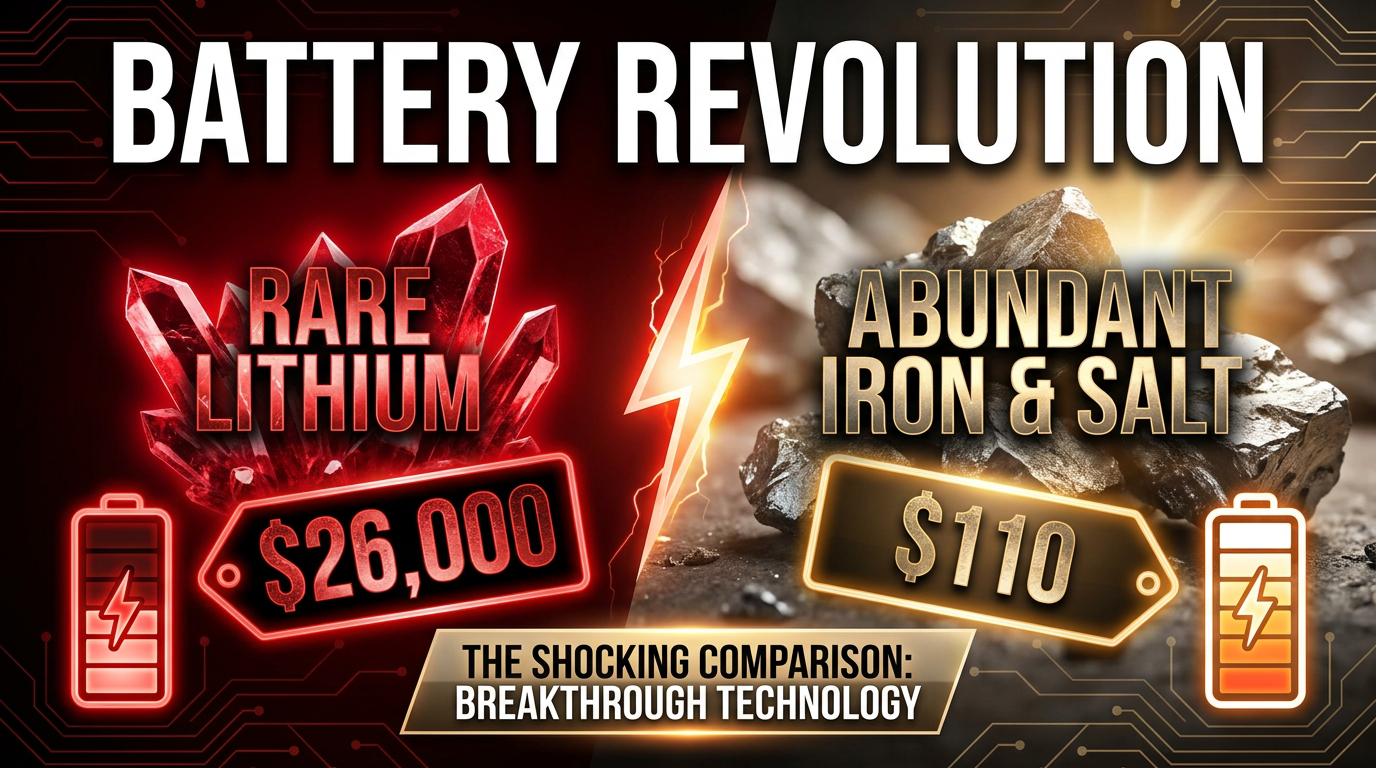
In April 2026, scientists at the Chinese Academy of Sciences disclosed development of an all-iron flow battery constructed entirely using iron, a commodity trading at approximately $110 per tonne. This contrasts sharply with lithium, which commands roughly $26,000 per tonne in market pricing. This dramatic cost disparity renders raw materials substantially more economical while ensuring consistent global availability across diverse geographic regions.
The research team demonstrated that their iron-based system completed above 6,000 consecutive charge-discharge cycles while maintaining stable capacity without degradation. This durability performance level positions the technology as particularly appealing for large-scale grid energy storage applications supporting renewable power integration.
China has additionally accelerated investment initiatives around sodium-derived battery technology. During 2024, a major sodium-ion battery energy storage installation commenced operations in Hubei Province. Engineered using sodium extracted from globally abundant salt reserves, the installation occupies an area equivalent to approximately 15 football fields and retains sufficient capacity to deliver electricity to roughly 12,000 residential consumers for continuous periods extending to 10 hours.
Iron-flow and sodium-ion battery systems differ fundamentally from lithium-ion configurations deployed in mobile electronics and automotive applications. These newer platforms concentrate development efforts on utility-scale energy storage rather than portable power delivery. While physical dimensions are larger and energy density lower relative to lithium systems, the alternatives provide critical advantages: substantially reduced expenses, utilization of common elemental resources, and potential to strengthen renewable electricity dependability across interconnected grid systems.
Iron represents one of the most prevalent metallic elements discovered in Earth's composition.
Salt exists abundantly across ocean environments throughout the globe.
Should these emerging technologies achieve continued maturation and commercialization, battery storage innovation may increasingly depend upon materials already familiar and universally accessible rather than restricted mineral resources.